
San Antonio VASH Voucher Ordinance: What You Need to Know
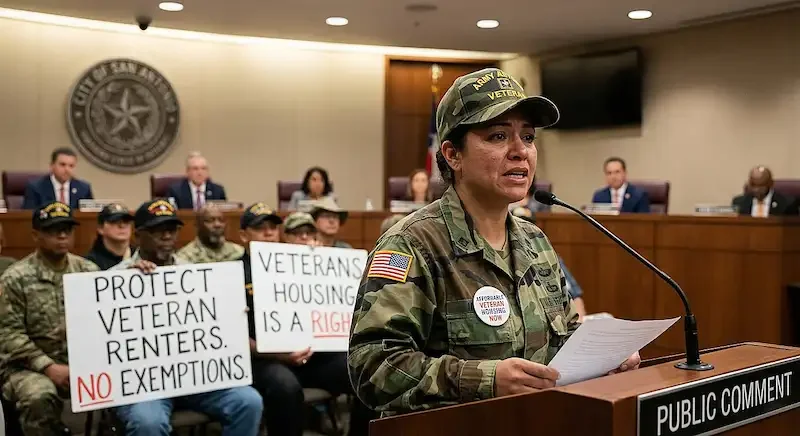
On May 7, 2026, the San Antonio City Council passed an ordinance. It created Source of Income (SOI) protections for military veterans. These veterans pay rent using a HUD-funded housing voucher. This includes the Housing Choice Voucher program (HCV, also known as Section 8) and HUD-VASH.
The version that passed differs greatly from the version that the team originally drafted. The differences matter for every property owner and manager in the city.
This post breaks down what became law for veterans and landlords including:
What changed from the original draft
Who is covered or who is exempt
What the penalties look like
What to expect at the 6-month review
Table of Contents
What the San Antonio VASH Voucher Ordinance Does
The ordinance bars a housing provider from refusing to lease a unit to a qualified veteran. This applies when the veteran uses a federal housing assistance program to pay rent. Common names for these vouchers are Housing Choice Voucher (HCV) or HUD VASH.
In plain terms, a veteran's voucher is now a lawful source of income for lease decisions at covered properties.
Source of income is not a protected class under the federal Fair Housing Act. HUD does not require state or local source of income protections.
Texas only allows cities extremely narrow authority here. Under Texas Local Government Code Sec. 250.007(b), San Antonio could either:
Apply SOI protections to all renters in any property receiving city incentives, or
Apply SOI protections to veterans only, in any property within city limits.
San Antonio chose the second path:
Veterans only
Citywide
Major exemptions
How the Ordinance Changed Before It Passed
The original draft and the version that passed are not the same document. Four substantive changes came in during PCDC review and the floor vote:
| Provision | Original Draft | Passed May 7, 2026 |
|---|---|---|
| Who is covered | All housing providers, no size threshold | Properties with 5 or more units only |
| Penalty type | Up to $500 per violation, with potential Class C misdemeanor framing | Administrative only, no criminal penalty |
| First violation | $500 fine | Written warning + mandatory compliance training, no fine |
| Second violation | Additional $500 fine per occurrence | Additional compliance training + $500 administrative fee |
| Third violation | Additional $500 fine per occurrence | Additional $500 fee + complaint advances through other means provided by law |
| Enforcement method | Inspections, monitoring, and complaint investigation | Complaint-based and proactive monitoring |
| Built-in review | Not specified | 6-month staff review back to City Council (November 2026) |
1. Small Landlord Exemption: 4 Units or Fewer Are Exempt
The original draft applied to every housing provider in the city, with no size threshold. The version that passed applies only to housing providers renting 5 or more units.
This is the single biggest change. The vast majority of San Antonio rental property owners own only one single-family or small multiplex.
Pew/Census data shows that individuals own 71.6% of U.S. rental properties. 42% of landlords own a single unit. Another 33% own 2 to 4 units.
One San Antonio property management firm reviewed its client list. It found that 71.5% of clients owned one rental home. All of those owners are now outside the scope of the ordinance.
The 5+ unit threshold also lines up with how many federal programs already operate. LIHTC properties, HOME-funded developments, and CDBG-supported buildings already have voucher acceptance requirements baked in.
2. The Criminal Penalty Was Removed
The original draft set a fine of up to $500 per violation. It also gave the city authority to enforce through “regular inspections, monitoring, and investigation of complaints.” Earlier discussions had referenced a Class C misdemeanor structure modeled on Fort Worth's 2024 ordinance.
The version that passed contains no criminal penalty. Enforcement is administrative only.
3. Tiered Enforcement Replaced the Flat Fine
Instead of a flat $500 fine on a first violation, the ordinance now uses an escalating structure:
First violation: Written warning plus mandatory compliance training with no fine.
Second violation: Additional mandatory compliance training plus a $500 administrative fee.
Third violation: An additional $500 fee, with the complaint advancing through other means provided by law.
A first-time mistake by a small property manager learning the rules now ends in training, not a fine. That is a meaningful change in posture from “punish the violation” to “fix the behavior first.”
4. Built-In 6-Month Review
The ordinance directs city staff to review implementation six months after adoption. Staff will report back to City Council on whether the ordinance is working and whether anything needs to change.
This is the part that should keep every San Antonio housing stakeholder paying attention. The 6-month review is the next decision point.
Whatever the data shows in November 2026 will determine whether the ordinance undergoes revision.
Who Is Covered and Who Is Exempt
| Property Type | Included? | What It Means |
|---|---|---|
| Single-family rental | Exempt | One door. The ordinance does not apply. |
| Duplex | Exempt | Two doors. The ordinance does not apply. |
| Triplex | Exempt | Three doors. The ordinance does not apply. |
| Fourplex | Exempt | Four doors. The ordinance does not apply. |
| 5+ unit apartment community | Included | Subject to the ordinance. Update screening criteria and train leasing staff. |
| Owner with multiple SFRs (5+ doors total) | Included | A typical reading covers an owner with five or more rental units in their name or under their management. |
| LIHTC, HOME, or CDBG-funded property | Included | Already required to accept vouchers under federal program rules, regardless of size. |
| Short-term rental (STR) | Exempt | Regulated separately under San Antonio's STR ordinance. |
Covered:
Owners or operators of rental properties with 5 or more units
All HUD federal housing assistance programs as defined in 24 C.F.R. § 5.100
Specifically named: Housing Choice Vouchers / HCV (Section 8) and HUD-VASH
Exempt:
Owners or operators of rental properties with 4 or fewer units
Single-family rentals (which represent the bulk of small-portfolio holdings in San Antonio)
Duplexes, triplexes, and fourplexes
This is a structural choice. Apartment communities and larger multi-family portfolios already participate in HCV and VASH at higher rates than individual single-family rental owners.
By setting the limit at 5 units, the ordinance puts pressure on landlords with more capacity. It keeps the smallest landlords outside the rule. This includes accidental landlords and veteran homeowners who recently PCS’d.
What “Sole Reason” Means in Practice
The ordinance applies only in one situation. It applies when someone denies a veteran housing solely because the veteran uses a federal voucher to pay rent.
A housing provider can still screen for and decline based on:
Credit history
Income-to-rent ratio (using the tenant's portion of rent for the calculation)
Rental history and prior evictions
Background checks
Pet policies
Smoking policies
Any other lawful, consistently applied screening criteria
What a covered housing provider cannot do is post “no Section 8” on a listing. They also cannot hang up when a caller says “VASH.”
If a veteran applicant meets the same screening criteria the property uses for every other applicant, the voucher itself is no longer a basis for denial.
How Complaints and Enforcement Work
A veteran who believes they were denied housing solely because of their voucher can file a complaint:
With the Neighborhood and Housing Services Department's Fair Housing Division
With the Office of Compliance, Opportunity and Access
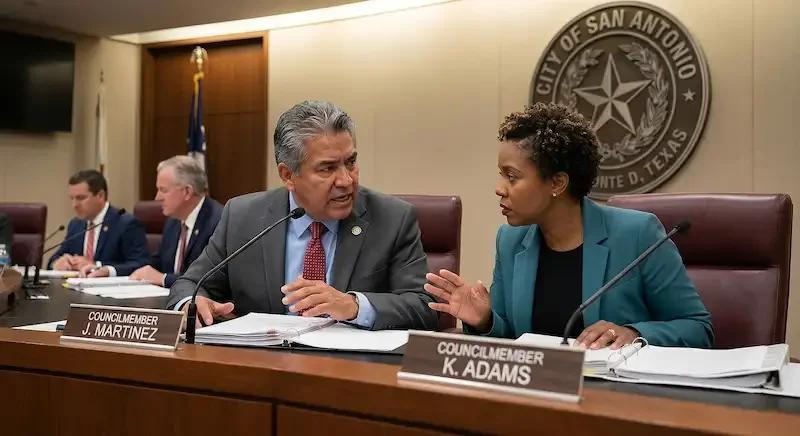
The city investigates. If a violation is found, the tiered enforcement structure is applied. Compliance training is the first response, not a fine.
What This Means for the 5+ Unit Operators Who Are Now Covered
If you own or manage an apartment community in San Antonio, the practical changes are:
Update screening procedures and written policies.
Make sure your application process treats voucher holders the same as any other applicant once income-to-rent ratios are calculated correctly.
The tenant's share of rent is what counts toward affordability, not the contract rent.
2. Train your leasing staff. A leasing agent saying “we don't take Section 8” on a phone call is a violation if the property is over 4 units.
Scripts and intake forms need updating before the ordinance takes effect.
3. Document your screening criteria in writing. Consistent, written, applied-to-everyone screening criteria are the strongest defense against any complaint.
4. Get familiar with the voucher process now, not after a complaint.
Inspection scheduling
HAP contracts
Rent reasonableness
Working with Opportunity Home or HABC
These are all things a covered property is going to encounter regularly.
The REACH Initiative has been working to improve this process for housing authorities. There is real, documented progress.
What's Already Improving Without the Ordinance
The city did not arrive at this ordinance in a vacuum. The REACH Initiative (Rental Engagement & Assistance to Connect with Housing) has been running since July 2024, bringing housing providers, both PHAs, SABOR, NARPM San Antonio, and HUD to the same table.
As of the March 2026 quarterly check-in, two recommendations are complete:
Per-property withdrawals replaced lump-sum clawbacks at Opportunity Home and HABC.
Clawback liability has shifted to the tenant, not the landlord.
The MLS now has a required HCV-acceptance field. February 2026 had 265 HCV-accepting listings, up from 92 in February 2025. That is a 188% year-over-year increase.
Other recommendations in progress include:
A master vacancy list
A 30-day rent guarantee from the Ready-to-Rent fund
Expanded PLACE program coverage
Aligned RTAs between the two housing authorities, Opportunity and Bexar County Housing Authority
And the shift to HUD's NSPIRE inspection standards (HABC completed this in October 2025; Opportunity Home plans summer 2026).
The COSA Vouches concept paper from Councilwoman Castillo proposed upfront incentive payments, FMR gap funding, and inspection improvements.
Opportunity Home’s Owner Incentive Program made 405 incentive payments to over 200 providers in 2023. About 10% were brand-new participants. The program ended after HUD funding cuts.
The infrastructure to grow voucher participation voluntarily has been moving for nearly two years. The ordinance now builds on that work for properties with five or more units.
Where the Numbers Stand Right Now
Some context for what the ordinance is responding to and what the 6-month review will be measuring:
Veterans in San Antonio: about 90,474
VASH voucher holders: 830 total, with 40 actively searching for housing as of March 2026
Veteran HCV holders: about 1,140 total, with an estimated 87 actively searching
Total veterans currently searching: approximately 127
MLS listings accepting HCV (March 2026): 194 of 2,293, or 8.5%
MLS HCV acceptance, year-over-year: up from 5.5% in 2024
San Antonio’s voucher placement story differs from Fort Worth’s. In Fort Worth, a 2018 HUD study found a 78% denial rate. Locally, housing providers have already housed 95.2% of VASH holders and roughly 92% of veteran HCV holders.
The 127 veterans searching form a small group, each with their own barriers. The ordinance covers buildings with five or more units, so it is a narrow tool. It targets only one part of the problem.
What to Watch Between Now and November 2026

The 6-month review is the date that matters next. City staff will be looking at:
Number of complaints filed
How many resulted in violations
Whether voucher-acceptance rates at 5+ unit properties moved
Whether the 127 veterans searching went down
Whether any unintended effects appeared (units pulled from the rental market, lawsuits, etc.)
If the data shows the ordinance moved the needle, expect it to stay or expand. If the data shows it did not, the talk will get serious.
Items that could change:
People may drop the 4-unit exemption.
They may change the penalty structure.
They may also add incentives like REACH and COSA Vouches have built.
If you are a housing provider, owner, or manager, you can help veteran housing access in this city.
Over the next six months, the best thing to do is gather your own data.
How many veteran applicants did you process?
What happened with each one?
What barriers actually came up?
That kind of ground-level information is what shapes what comes next.
Frequently Asked Questions
-
Source of income is the lawful money a renter uses to pay rent. That can include wages, pensions, child support, Social Security, VA disability, or a HUD-funded voucher. Examples are HCV and VASH.
Under this San Antonio ordinance, a covered housing provider cannot refuse a qualified veteran.
They also cannot refuse them solely because their income is a federal voucher.
Source of income is not a protected class under the federal Fair Housing Act.
That is why Texas had to let cities add this protection for veterans.
-
No. The ordinance applies only to housing providers renting properties with 5 or more units. Single-family rentals, duplexes, triplexes, and four-plexes are exempt.
-
The ordinance addresses leasing for rental housing. San Antonio’s STR ordinance regulates short-term rentals separately. They are not a typical option for a Section 8 or VASH placement.
-
The ordinance language ties to housing rented by a single housing provider. A typical reading is that the coverage applies to an owner with five or more rental units. The units must be in their name or under their management. Owners with four or fewer are exempt.
-
Yes. The ordinance only prohibits refusing rent solely because the veteran's source of income is a federal voucher. Standard, consistently-applied screening criteria like credit, rental history, background checks, and income-to-rent ratios all still apply.
-
Local administrators manage both federally funded vouchers. Section 8 (Housing Choice Voucher) is the broader program for low-income households.
VASH (Veterans Affairs Supportive Housing) is for veterans who have experienced homelessness. It pairs the voucher with VA case management.
Both are covered by this ordinance.
-
That is permissible under the ordinance, as long as the same credit standard is applied to every applicant. Document the screening criteria in writing and apply them consistently.
-
The ordinance is effective immediately.
-
Six months after adoption, city staff will report to City Council. They will cover implementation, complaints, outcomes, and any recommended changes. That review determines whether the ordinance stays in place, gets adjusted, or expands.
What Comes Next
This ordinance is a starting point, not an ending point. The 6-month review will tell us whether it actually changed voucher access for the 127 veterans currently searching. If it did, the model holds. If it didn't, the city has six months of data to figure out whether more carrots or different sticks are the next move.
For owners and operators with five or more units: update your written screening criteria. Train your leasing staff before the first complaint arrives. For owners under that limit: the ordinance does not apply to you.
But the talk about voucher access in San Antonio is not over.
Work through REACH and COSA Vouchers will still shape this market.
If you have questions about how this ordinance affects a property in your portfolio, reach out. We can talk through your situation. If you have questions about voucher participation, reach out.
Thank you!
We got your information and someone from our team will reach out shortly.