
How Long Will Your San Antonio Rental Sit in the October–February Off-Season?
How long does it take to rent a house in San Antonio? In the May-through-August peak, a well-presented, correctly positioned single-family rental generally leases in about two to four weeks. List that same house in late October and a realistic plan is four to eight weeks, with the stretch from Thanksgiving to New Year's the slowest run of the year. That is a swing of roughly double, and it is not a verdict on your house. It is seasonality - predictable, well documented nationally, and something you can plan around if you start now rather than in December.
That planning is the whole point of this guide. San Antonio owners are setting October list dates right now. The decisions you make in the next two weeks determine whether you spend the winter carrying an empty house, and whether the lease you eventually sign expires in the best month of the year or the worst one.
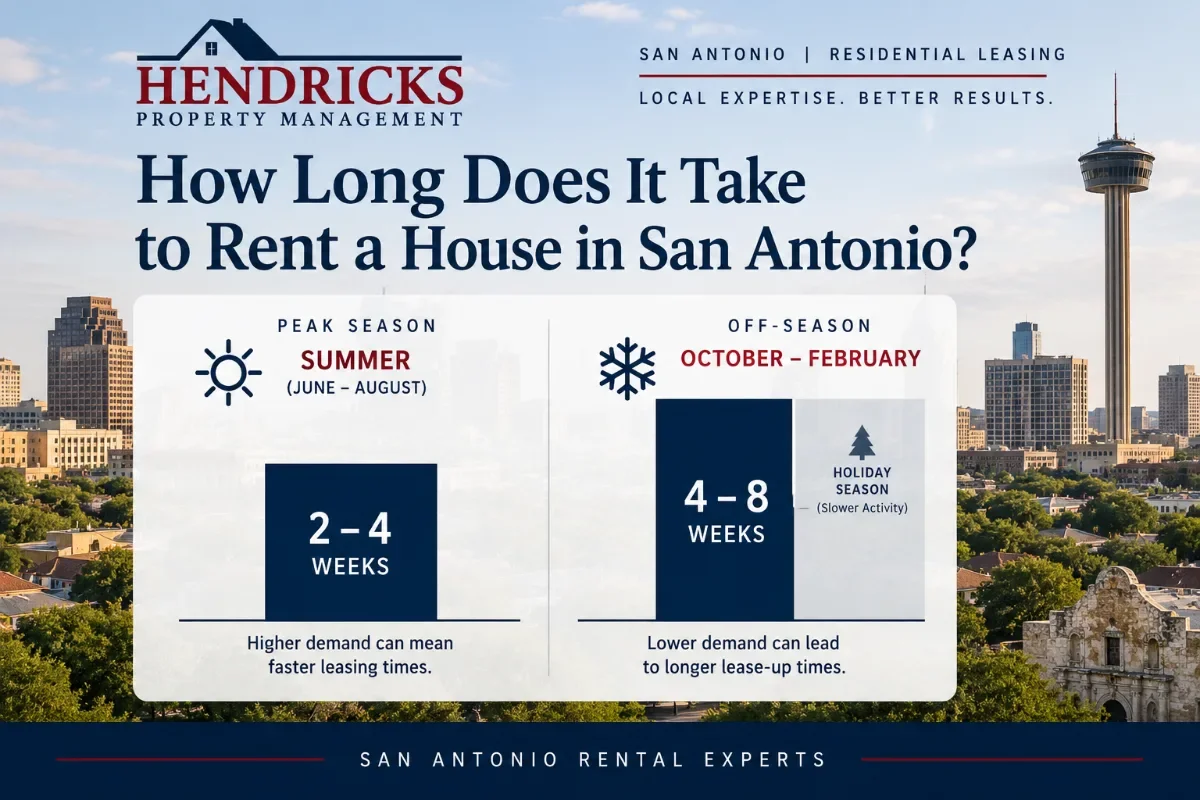
No public data source publishes days-on-market for San Antonio single-family rentals. Zillow, Apartment List, and CoStar all report rents and vacancy, not house-level leasing times, and the Bexar County MLS does not release rental DOM publicly. The two-to-four and four-to-eight week ranges above are planning ranges built from two verified inputs: national research showing rental moves collapse in the fall and winter, and San Antonio's unusually high local vacancy. We would rather tell you that than invent a local number. Current as of September 2026.
What the seasonality data actually shows
The national pattern is well established. Apartment List's research on rental market seasonality found that rental moves begin climbing in March and peak in August, then fall away through the final months of the year, while rental searches don't pick back up until the December-to-January jump - and those early-year searchers are slower to act. Renters who start looking in July are far more likely to move within 30 days than renters who start in January; renters who begin in the first quarter are about 10% less likely to move at all.
Translate that to your vacant house. In October you are not just facing fewer renters. You are facing a pool with a higher share of window-shoppers, longer decision timelines, and less urgency. The same listing that drew nine inquiries and three applications in June draws four inquiries and one soft maybe in November.
Now layer San Antonio on top. CoStar's ranking of apartment vacancy rates put the metro at a 15.7% apartment vacancy rate in Q1 2026 - the highest of the 50 largest U.S. apartment markets, ahead of Memphis, Austin, and Houston - after a multi-year wave of new apartment delivery. CoStar forecast 15.1% for 2026 as a whole, easing to 14.4% in 2027. Meanwhile Apartment List's San Antonio rent report showed the city's median rent at $1,123 in September 2026, down 4.9% year over year, trailing both Texas (-2.5%) and the nation (-0.8%).
Those are apartment numbers, and your detached house with a yard is not competing head-to-head with a mid-rise. But renters shop across both. When a third of San Antonio apartment operators are running concessions - RealPage concession tracking counted 31.6% of San Antonio apartment landlords offering incentives in January 2026, averaging 11.6% off - that resets what a renter thinks a good deal looks like before they ever tour your property.
The San Antonio leasing calendar, month by month
| Month | Applicant pool | Realistic planning window | Owner move |
|---|---|---|---|
| September | Still decent; tail of summer | 3–5 weeks | Last clean window - list now if you can |
| October | Drops noticeably | 4–6 weeks | Photos and pricing must be right on day one |
| November | Thin | 5–8 weeks | Consider odd-length terms; keep showings fast |
| December | Thinnest of the year | 6–10 weeks | Holidays stall decisions; hold quality, flex on term |
| January | Searches restart, moves lag | 5–8 weeks | Volume returns before signatures do |
| February | Building | 4–6 weeks | Position for a spring move-in date |
| March–April | Strong | 2–4 weeks | Renewal conversations should already be done |
| May–August | Peak; PCS and school-year moves | 2–3 weeks | Best pool, best terms, best renewal leverage |
Read that table as a bet, not a promise. A three-bedroom in a well-regarded Northside school zone at a sensible rent will beat these ranges. A dated four-bedroom with a strict pet policy and weekday-only showings will miss them in any month.
Who is still moving between October and February
The off-season pool is thinner, but it is not empty - and knowing exactly who is in it tells you how to market. Three groups keep moving all winter in Bexar County.
Service members on off-cycle orders. The military's peak moving season runs May through August, which is why summer near Lackland, Fort Sam Houston, and Randolph is so reliably fast. But orders drop every month of the year. Winter military PCS arrivals are fewer, and they are exactly the renter you want in December: they have a hard report date, a housing allowance, and no interest in negotiating for three weeks. They need a home they can occupy quickly, and they are usually searching from out of state.
Job relocations. San Antonio's employer base keeps hiring through the winter, and corporate start dates cluster in January. These renters behave much like PCS families - fixed date, remote search, decisive once they find a fit.
Lease-break replacements. Every winter, a share of existing tenants across the city need out of a lease early, which pushes a steady trickle of renters into the market on short notice. If you're on the other side of that situation with your own tenant, our guide to how to break a lease in Texas covers what Texas law actually requires and what a reletting fee can and can't do.
What these three groups have in common matters more than their differences: they are all time-constrained and most of them are searching remotely. That single fact should drive every marketing decision you make this fall.
An out-of-state PCS family will shortlist three homes from photos alone and put in an application on one they've only seen by video. If your listing has 12 phone photos and no floor plan, you're invisible to the most decisive renters in the winter market.
Lease-length strategy: get your expiration back into the summer
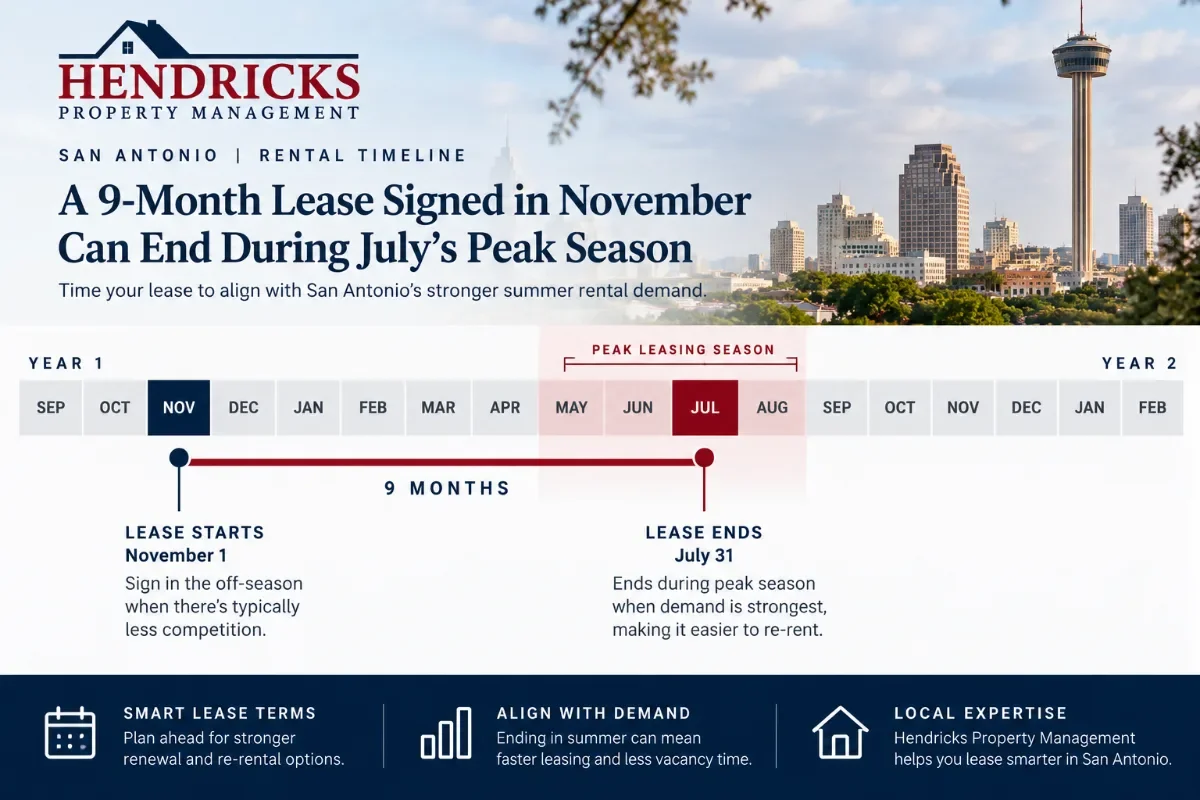
Here is the move most San Antonio owners miss. If you sign a standard 12-month lease in November, that lease expires the following October - and you are right back in the worst window, permanently, year after year. A single odd-length term breaks the cycle.
The rule is simple: aim for a June, July, or August expiration. Work backwards from there.
| Move-in | Term | Expires | Lands in | What it's worth |
|---|---|---|---|---|
| Nov 1 | 12 months | Oct 31 | Off-season trough | Locks you into re-listing in the slow window every year |
| Nov 1 | 9 months | Jul 31 | Peak PCS + school-year window | Strongest renewal leverage; best re-lease pool |
| Dec 1 | 8 months | Jul 31 | Peak | Same reset, one holiday month of carry avoided |
| Jan 1 | 7 months | Jul 31 | Peak | Short but surgical; renew into a 12-month at peak |
| Dec 1 | 6 months | May 31 | Front edge of peak | Good; slightly early but the pool is already building |
| Feb 1 | 12 months | Jan 31 | Off-season trough | The trap - a full year to the wrong month |
What is the reset actually worth? Run it on a house renting for $1,900. If a summer expiration cuts your next vacancy from six weeks to three, that is roughly $1,300 in recovered rent, every single turnover, for as long as you own the property. It also puts your renewal conversation in the month when your tenant has the most reason to stay put and the least appetite for a move.
The trade is real: you are accepting a shorter term now, and short terms mean turnover risk sooner. Two things reduce that risk. First, an odd-length term is easy to convert - at the end of a 9-month lease you are negotiating a 12-month renewal in July, from a position of strength. Second, plenty of winter renters actively want a short term lease because their own timeline is uncertain, which means the odd length is a selling point, not a concession.
A 7-month lease is a reset tool, not a business model. If you roll a tenant from a 7-month into a 6-month into another 6-month, you've bought three turnovers in eighteen months and burned any savings on make-ready and marketing. Use the odd term once, then renew long.
Marketing into a thin applicant pool
When there are fewer renters, the gap between a good listing and an average one widens. In June an average listing still leases. In December it sits.
Photography carries more weight than anything else. Winter light in San Antonio is flat and the yards look tired. Shoot on a bright day, shoot wide, get every room plus the yard and the garage, and add a walkthrough video. If a renter can tour by video at 10 p.m. from Ohio, you've just qualified for the most motivated segment of the winter market. Look at how the strongest available San Antonio rental homes present themselves and match that bar.
Put a real availability date on the listing. "Available now" and "available soon" convert very differently to someone with a January report date. State the exact date the home can be occupied, and if you can be flexible on it, say so in the listing copy rather than waiting to be asked.
Showing responsiveness is the cheapest edge you have. In a thin pool the renter who inquires on Tuesday has probably inquired on four homes. Whoever answers first, and can show first, usually wins. Weekend and evening availability matters disproportionately in the off-season, when the people moving are relocating around work.
Broaden the pet policy before you broaden anything else. A large share of renters have pets, and a blanket no-pets rule cuts your winter pool at exactly the moment you can least afford it. A pet policy with a reasonable deposit and clear weight or breed terms costs you very little and opens the funnel meaningfully.
Fix the small things that read as neglect. Chipped paint, a dead patch of lawn, a dirty oven, a slow-draining sink. In peak season a renter forgives these because options are scarce. In December they simply move to the next listing.
Two weeks after listing, check one number: showings, not inquiries. Plenty of showings and no applications means presentation or terms. Almost no showings means the listing - photos, availability date, or position - is the problem. Fix the right thing.
When to hold firm and when to flex
Not every winter vacancy calls for a concession. Use this order.
Hold firm on screening. Income standards, rental history, and background criteria are the last thing to loosen, in any season. A tenant you would not have approved in June will not become a better tenant in December - and the cost of getting this wrong is far higher than a few extra weeks of vacancy. Our walkthrough of the eviction process in San Antonio is a useful reminder of what a bad approval actually costs in time and money. Apply your criteria consistently to every applicant.
Hold firm on condition. Deferred maintenance does not become cheaper by being postponed, and a home in poor condition attracts applicants who are being turned down elsewhere.
Flex on lease term first. This is the lowest-cost lever you have. Offering a 7-, 8-, or 9-month term costs you nothing today and buys you a summer expiration. It also widens your pool to every renter whose own timeline is short.
Flex on move-in date and small incentives second. A flexible start date, a waived application fee, or a modest move-in credit are all cheaper than a month of vacancy on a $1,900 house - one empty month is roughly $1,900 gone and unrecoverable.
Adjust your asking rent last, and only on evidence. If you've had strong showing traffic for three weeks and no applications, the number is the issue and a modest correction beats another month empty; the metro-wide concession activity noted earlier is the context your applicants are shopping in. But reach for that lever after term, date, and presentation - not before. A rent reduction is permanent for the length of the lease, while a shorter term is temporary by design.
SA Rents manages single-family rentals across San Antonio and Bexar County, including a large share of homes near JBSA. We'll look at your property, your current lease dates, and this season's competition, and tell you plainly whether to list in October, hold for spring, or use an odd-length term to move your expiration where it belongs. Reach out for a straight answer on your house.

This article is general information for rental property owners, not legal advice. Confirm lease terms and screening practices with a Texas attorney or licensed property manager. Market figures current as of September 2026.
Frequently Asked Questions
How long does it take to rent a house in San Antonio right now?
Plan on roughly two to four weeks for a well-presented home listed in the May–August peak, and four to eight weeks for the same home listed between late October and February. Those are planning ranges, not published statistics - no public data source reports days-on-market for San Antonio single-family rentals specifically. See the note in the article on how we get to those numbers.
Why does it take longer to rent out a house in the winter?
Fewer households move. Apartment List's seasonality research shows moves peak in August and stay quiet through the start of the year, while searches don't ramp until January. On top of that, San Antonio's own supply glut means your house competes with a very large pool of vacant units, so a thin applicant pool has more places to go.
Should I accept a 6 month lease to fill a winter vacancy?
Often yes - but do the math on where it expires. A 6 month lease signed December 1 ends May 31, right at the front edge of peak season, which is excellent. A 6 month lease signed October 1 ends March 31, which is only okay. The goal is a June, July, or August expiration.
Is a 7, 8, or 9 month lease legal in Texas?
Yes. Texas does not restrict residential lease terms to 12 months. Any fixed term the two parties agree to in writing is enforceable, and odd-length terms are a normal tool for resetting a renewal calendar.
How does military PCS timing affect my vacancy?
Military PCS moves cluster in the May-through-August window, which is what makes San Antonio's summer so strong near Lackland, Fort Sam Houston, and Randolph. Orders still drop year-round, though, so a small but real stream of service members is house-hunting in December and January - and they usually need a fast move-in.
Does a short term lease let me charge more?
Industry guidance commonly suggests a premium for short term lease terms of a few months or month-to-month, but we could not find rigorous published data on premiums for 7-, 8-, or 9-month residential leases. Treat any premium as a negotiating position, not a market rate - and weigh it against the value of a summer expiration.
What is the San Antonio rental vacancy rate?
CoStar put the metro apartment rental vacancy rate at 15.7% in Q1 2026 - the highest among the 50 largest U.S. apartment markets - and forecast 15.1% for full-year 2026. That figure is apartments, not houses, but it tells you how much competing supply is out there.
Should I lower my asking rent or wait for the right applicant?
Neither by default. Work through the hold-firm-versus-flex guide in this article. If you have steady showings but no applications, the issue is usually presentation or terms. If you have no showings at all after two weeks, the listing itself is the problem.