
How Many People Can Legally Live in Your San Antonio Rental? Occupancy Limits Under Texas Law (2026)
Under Texas Property Code Sec. 92.010, the maximum number of adults a landlord may allow to occupy a dwelling is three times the number of bedrooms. So the short answer to how many people can live in a 2 bedroom apartment in Texas: up to six adults by statute, and children under 18 are not counted at all. That is the legal ceiling, not a recommendation. Most San Antonio owners set a tighter written policy, and the rest of this guide covers how to do that without stepping into a fair housing problem.
This is general information, not legal advice, and is current as of September 2026. Talk to a Texas attorney about your specific lease and property.
The Texas statutory occupancy limit, exactly
Occupancy is one of the few tenancy questions Texas answers with a hard number. Texas Property Code Section 92.010 says a landlord may not allow more than three adult occupants per bedroom, defines an "adult" as an individual 18 years of age or older, and defines a "bedroom" as an area of a dwelling intended as sleeping quarters - specifically excluding kitchens, dining rooms, bathrooms, living rooms, utility rooms, and closets or storage areas.
Two things surprise owners here. First, the cap runs against you, the landlord. The statute restricts what a landlord may allow, and it gives a neighbor within 3,000 feet - or a governmental entity or civic association acting for that neighbor - the right to sue to enjoin the violation and recover $500 per violation plus court costs and attorney's fees. Second, the statute counts only adults. A family of two parents and five children is well inside the cap in any one-bedroom unit in Texas.
The statute lists exactly two exceptions. A landlord may allow more than three adults per bedroom to the extent required by a state or federal fair housing law, and where an adult whose occupancy causes the violation is seeking temporary sanctuary from family violence for a period not exceeding one month.
Texas maximum vs. the HUD guideline, side by side
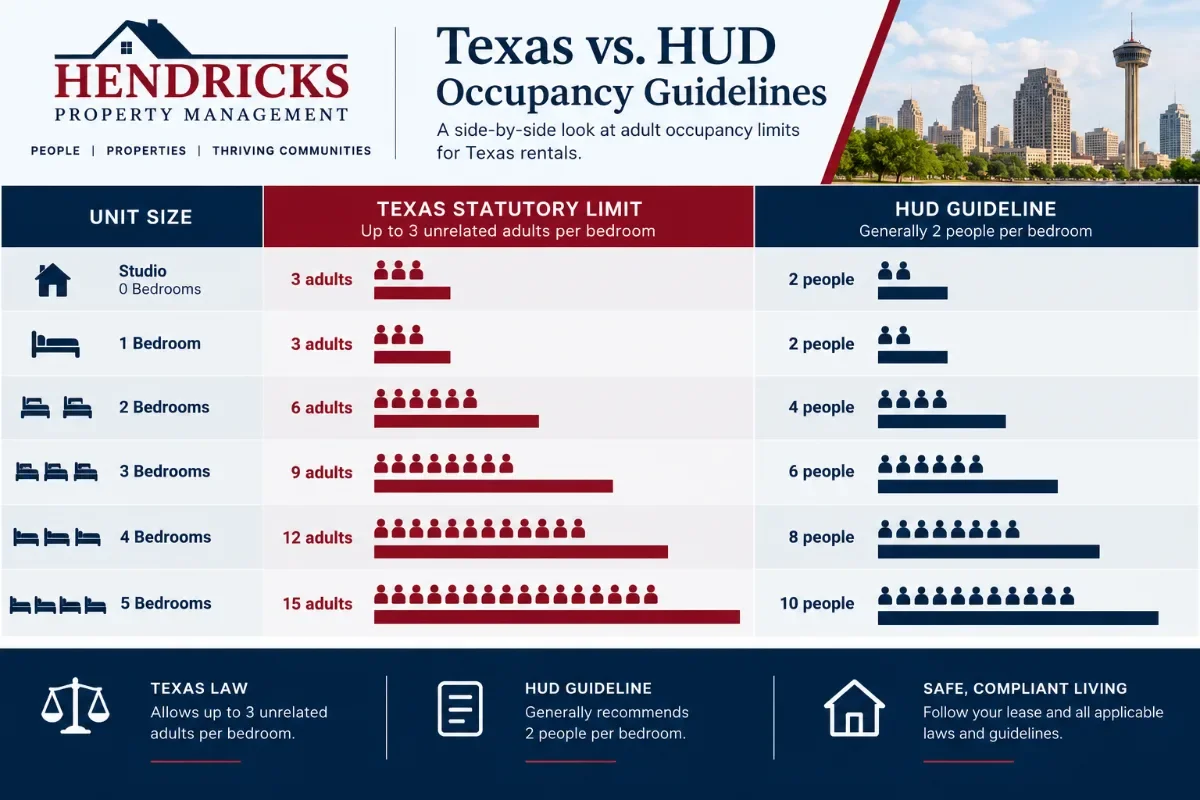
Two numbers govern your decision. The state cap is law. The HUD figure is guidance used to evaluate familial status complaints. Your written policy should sit between them.
| Unit size | Texas statutory maximum (adults only) | HUD "two per bedroom" guideline (all people) |
|---|---|---|
| Studio / efficiency | Treated case by case; no bedroom | 2 |
| 1 bedroom | 3 adults | 2 |
| 2 bedrooms | 6 adults | 4 |
| 3 bedrooms | 9 adults | 6 |
| 4 bedrooms | 12 adults | 8 |
| 5 bedrooms | 15 adults | 10 |
The gap is enormous, and that is the whole point. Texas counts adults; HUD counts people. A three-bedroom house could legally house nine adults under state law while a two-per-bedroom private policy would suggest six people. Neither number is automatically the right answer for your property.
Two persons per bedroom plus one for the unit (so 5 in a 2-bedroom, 7 in a 3-bedroom) is the policy most Texas operators land on. It respects the HUD guideline, leaves room for a new baby or an aging parent, and sits comfortably under the state cap. Put the number in the lease and apply it to every applicant identically.
Where HUD's two-per-bedroom standard comes from, and its status today
The "two persons per bedroom" figure traces to a March 20, 1991 memorandum from HUD General Counsel Frank Keating - the Keating memo. In 1998 Congress, through Section 589 of the Quality Housing and Work Responsibility Act, directed HUD to adopt the specific and unmodified standards in that memo as its policy for familial status complaints involving a housing provider's occupancy standard. HUD published it as HUD's occupancy standards statement of policy at 63 FR 70256 on December 18, 1998, with the memo attached in full.
Read what it actually says. HUD's position is that "an occupancy policy of two persons in a bedroom, as a general rule, is reasonable" - but that the reasonableness of any occupancy policy is rebuttable, and HUD will not decide compliance based solely on the number of people per bedroom. It is a guide, not a safe harbor. The memo then lists the factors that can push the reasonable number up or down:
- Size of the bedrooms and the unit. Large bedrooms and spacious living areas argue for allowing more people; a small two-bedroom mobile home argues for fewer.
- Configuration of the unit. A two-bedroom with a den or study can support more occupants than one without.
- Age of the children. Two adults plus an infant in a large one-bedroom reads differently than two adults plus a teenager.
- Other physical limitations, including the capacity of septic, sewer, or other building systems.
- State and local occupancy requirements. If your policy mirrors a governmental requirement, HUD treats that as a special circumstance tending to show the policy is reasonable.
- Evidence of pretext, such as discriminatory statements, rules aimed at children's use of common areas, capping how many units go to families with children, or enforcing the policy only against families.
On the current status: HUD's Office of Fair Housing and Equal Opportunity withdrew eight fair housing guidance documents in a notice effective September 17, 2025 and published in April 2026. We checked that list. The 1998 occupancy standards policy and the Keating memo are not on it, and one of HUD's own stated criteria for retention is that the guidance is statutorily prescribed - which this one is, by Section 589. Owners should still watch this space, because HUD's 2026 notice withdrawing fair housing guidance states FHEO is continuing to review its guidance and will reissue what it deems necessary.
Local codes: bedroom size in San Antonio
City code addresses square footage rather than headcount. The San Antonio Property Maintenance Code requires every living room to contain at least 120 square feet, every bedroom at least 70 square feet, and every bedroom occupied by more than one person to contain at least 50 square feet of floor area per occupant. The code also has an overcrowding provision letting the code official act where the number of occupants endangers the health or safety of the occupants, and it prohibits kitchens and non-habitable spaces from being used for sleeping.
Run the math before you write a number into a lease. A 110-square-foot bedroom supports two occupants under the 50-square-foot rule; a 90-square-foot bedroom does not. If your property sits outside city limits in unincorporated Bexar County or in a suburb like Schertz, Converse or Helotes, local codes vary - confirm the applicable standard with that jurisdiction's code enforcement office before relying on the San Antonio figures.
Occupancy policies are the most common way a well-meaning owner creates disparate-impact exposure against families with children. A "two people per unit" rule in a two-bedroom, a "one person per bedroom" rule, or any policy phrased as a limit on children rather than people will be read as a pretext for excluding families. HUD's own guidance says a policy limiting the number of children per unit is less likely to be reasonable than one limiting the number of people. Write the standard once, base it on bedrooms and square footage, and enforce it against every household the same way.
Familial status - households with someone under 18, plus pregnant applicants and those in the process of adopting or fostering - is a protected class under the federal Fair Housing Act. You do not need discriminatory intent to be liable. A neutral-sounding occupancy rule that screens out families more often than other households can be challenged on its effect alone, and the burden shifts to you to show the rule is necessary and that no less restrictive alternative would work.
When a guest becomes an occupant
Texas statute does not answer this. There is no 14-day rule or 30-day rule in the Property Code that automatically converts a guest into a tenant. It is purely a matter of lease drafting, and if your lease is silent you have nothing to enforce.
Courts and judges look at conduct rather than the calendar: how long the person has been there continuously, whether they receive mail at the address, whether they have a key, whether their belongings are stored there, whether they contribute to rent or utilities, and whether they list the unit as their residence.
The lease language that makes this enforceable does four things:
- Names every occupant. List each adult tenant and each named minor occupant by name in the lease, and state that only listed persons may occupy the unit.
- Defines a guest with a number. For example: no guest may stay more than 14 consecutive days, or more than 21 total days in any six-month period, without prior written consent.
- States what happens when the limit is crossed. A guest who exceeds the limit is deemed an unauthorized occupant, which is a material lease violation.
- Sets the cure. The occupant must vacate, or apply and qualify to be added to the lease, within a stated number of days after written notice.
Reasonable accommodation requests, live-in caregivers and short-term family-violence sanctuary situations are exceptions you should handle case by case rather than by blanket rule.
Adding a roommate the right way
When a tenant asks to add a partner, a relative or a roommate, treat it as a new application, not a favor. The sequence:
- Get the request in writing and confirm the unit still fits your occupancy policy and the square-footage minimums.
- Screen the applicant to your published standards - income, credit, rental history, criminal background - using the exact same criteria you applied to the current tenants.
- Amend the lease. Either sign a lease addendum adding the new person as a co-tenant, or issue a new lease. Never rely on a verbal okay or a text message.
- Make liability joint and several. Every adult on the lease should be individually responsible for the full rent and for all damages, not a share. That is what lets you pursue any one of them if the household falls apart.
- Address the deposit. Decide whether the deposit increases, and state plainly that you will not split or refund the deposit between roommates - it is returned once, at the end of the tenancy.
- Encourage a roommate agreement between the tenants covering rent splits, chores and move-out notice. It is a private contract between them and does not bind you, but it prevents most of the disputes that land on your desk.
A roommate who later wants out cannot simply walk. Removing someone from a lease requires your written consent and a signed amendment, and the departing tenant should understand the rules on how to break a lease in Texas before assuming they can hand over their key and be done.
Subletting and assignment
Texas gives you the default here. Texas Property Code Section 91.005 provides that during the term of a lease the tenant may not rent the leasehold to any other person without the prior consent of the landlord. Courts have applied that prohibition to assignments as well. The protection exists solely for the landlord's benefit, so only you can act on a violation.
Even with the statute in your favor, spell it out in the lease. A workable subletting clause prohibits subletting, assignment and any short-term rental listing without prior written consent; states that consent may be conditioned on the subtenant passing your screening; and makes an unauthorized sublet a material breach. If a tenant sublets anyway, you can pursue eviction of the subtenant and recover damages from the original tenant, including the cost of removing the subtenant.
Airbnb and midterm rental listings are the most common form of unauthorized subletting we see in Bexar County. Name short-term rentals explicitly in your subletting clause - a tenant who reads "sublease" narrowly may argue a 3-night booking is not one.
Unauthorized occupant discovered: what to do, in order
- Document before you act. Note dates, take dated photos of what you legitimately observe, and save any texts, vehicle records, mail observations or neighbor reports. Do not enter the unit outside your lease's access terms.
- Verify the occupancy math. Confirm the household actually exceeds your written policy or the statutory cap. Remember that children do not count toward the Sec. 92.010 number.
- Send written notice. Cite the specific lease clause, describe the violation factually, and give a clear deadline.
- Offer the cure. Either the person vacates by the stated date, or they submit an application and, if they qualify, are added to the lease by written amendment. Most cases resolve here.
- Re-screen and paper it, or escalate. If the tenant refuses both options, the unauthorized occupancy is a lease violation. Issue the notice to vacate your lease and Texas law require, then proceed through the courts.
- Never self-help. Do not change locks, remove belongings or cut utilities. Removal runs through the courts, and the eviction process in San Antonio has notice requirements you have to follow precisely or you will lose on procedure.
Pull your current lease and check four things: a named-occupants clause, a numbered guest limit, a subletting and assignment prohibition, and a written occupancy standard tied to bedrooms. If any one of those is missing, you have no clean way to enforce the other three.
The bottom line for San Antonio owners
Texas gives you a generous statutory ceiling of three adults per bedroom. HUD gives you a guideline of two people per bedroom. City code gives you a floor-area minimum. Your job is to set one written policy that respects all three, apply it identically to every household, and back it with lease language that names occupants, limits guests and prohibits unauthorized subletting. Get that right and the occupancy question stops being a judgment call every time it comes up.
If you would rather not draft and enforce that yourself, SA Rents handles lease drafting, applicant screening and occupancy compliance for owners across San Antonio and Bexar County - and you can see our current San Antonio homes for rent any time.
Not sure your lease would hold up if a long-staying guest refused to leave? SA Rents manages single-family and small multifamily rentals throughout San Antonio and Bexar County, with Texas-compliant leases, consistent screening and documented enforcement. Reach out for a free rental analysis and lease review.
Frequently Asked Questions
How many people can live in a 2 bedroom apartment in Texas?
Under Texas Property Code Sec. 92.010, a landlord may allow up to three adults per bedroom, so a two-bedroom unit tops out at six adults. Children under 18 are not counted toward that cap. Most Texas owners set a lower written policy - commonly two people per bedroom plus one - because the state cap is a ceiling, not a recommendation.
How many people can live in a 3 bedroom house under Texas law?
The statutory maximum is nine adults (three times three bedrooms), with no cap on the number of children. HUD's long-standing guideline of two persons per bedroom would suggest roughly six people as a generally reasonable private policy for a three-bedroom house.
Do children count toward the Texas occupancy limit?
No. Sec. 92.010 defines an 'adult' as someone 18 or older and counts only adults. That is deliberate - counting children would collide with the Fair Housing Act's protection for familial status.
What counts as a bedroom?
Texas defines a bedroom as an area intended as sleeping quarters. The statute specifically excludes kitchens, dining rooms, bathrooms, living rooms, utility rooms, and closets or storage areas. A converted garage or a windowless study generally does not count.
How long can a guest stay before they become a tenant in Texas?
Texas statute sets no fixed number of days. There is no magic 14-day or 30-day rule in the Property Code. Whether someone is a guest or an occupant is decided by your lease language and by conduct - mail delivery, a key, storage of belongings, contributing to rent. If your lease is silent, you have no line to enforce.
Can a tenant sublet or put the unit on Airbnb without asking me?
No. Texas Property Code Sec. 91.005 states that during the term of a lease a tenant may not rent the leasehold to any other person without the prior consent of the landlord. Courts have applied it to assignments as well. Your lease should still spell out the rule and the consequences so enforcement is clean.
What do I do if I find an unauthorized occupant?
Document it, send written notice citing the lease clause, then offer a path to cure - either the person leaves by a stated date or applies to be added to the lease and passes your standard screening. If neither happens, the unauthorized occupancy is a lease violation you can act on. Do not change locks or remove belongings on your own.
Can I refuse to rent to a family with several children?
Not on that basis. Familial status is protected, and an occupancy policy that is stricter than necessary can be challenged as a pretext for excluding families with children. Apply one written, neutral, people-based standard to every applicant - never a limit on the number of children.