
How Much Do Property Managers Charge in San Antonio? A 2026 Fee Breakdown for Owners

Why San Antonio Property Owners Ask This Question First
If you are weighing whether to hire a property manager for a San Antonio rental, the fee structure is usually the first thing you want to understand, and reasonably so. Property management fees directly affect your net return, and fee structures are not standardized across the industry, which makes comparing one company's proposal to another's harder than it should be.
This guide breaks down the fee categories you will typically encounter in the San Antonio market, using general industry ranges rather than any single company's pricing, so you can walk into a conversation with a property manager already knowing what questions to ask.
The percentages and fee ranges below reflect typical patterns reported across the Texas property management industry and are meant as general market context, not a quote from SA Rents or any specific company. Always request a written, itemized fee schedule directly from any property manager you are evaluating.
The Main Fee Categories Owners Should Expect
Most full-service property management agreements in San Antonio are built from some combination of the following charges.
1. The Monthly Management Fee
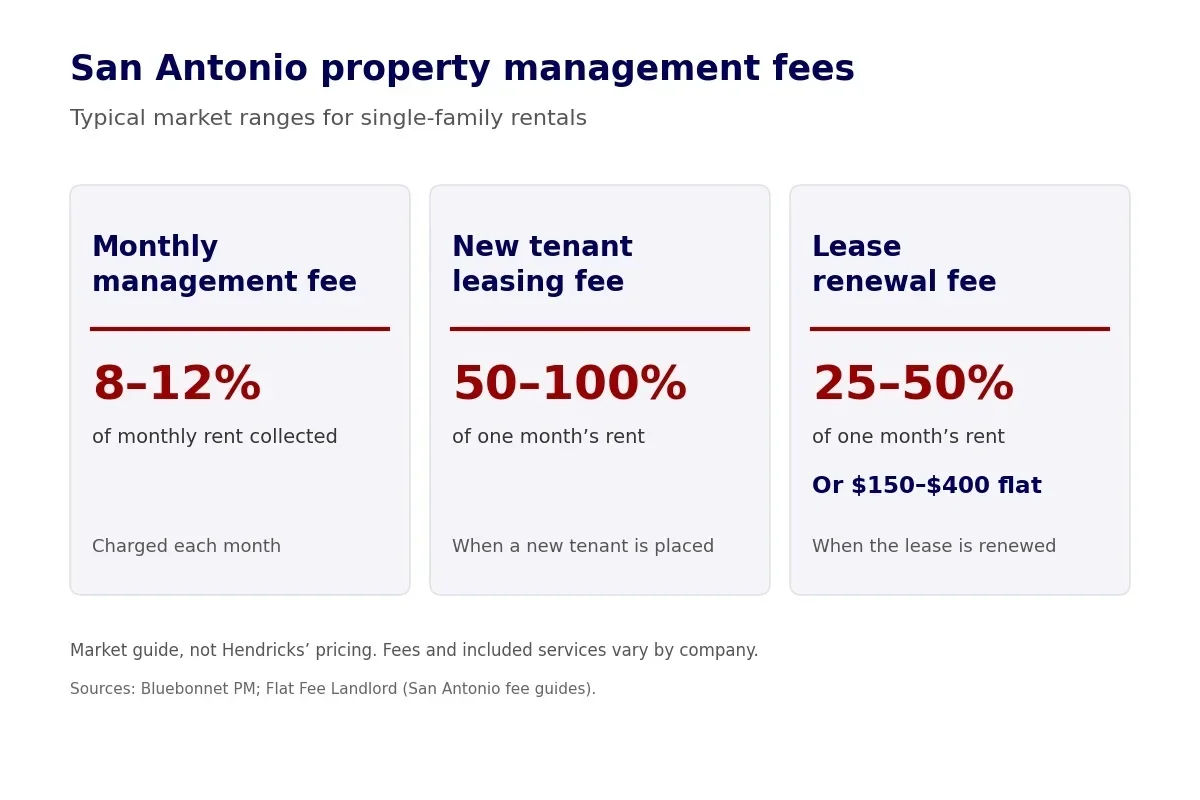
This is the recurring fee that pays for the day-to-day work of managing an occupied rental: collecting rent, handling tenant communication, coordinating maintenance requests, and providing owner statements. In the San Antonio market and comparable Texas metros, this fee is commonly structured as a percentage of collected rent, often somewhere in the 8 to 12 percent range, though a breakdown of typical Texas property management fees shows the range can run wider depending on property type and service level.
A smaller number of companies charge a flat monthly dollar amount instead of a percentage. A flat fee can work out cheaper for higher-rent properties and more expensive for lower-rent ones, so it is worth running the math both ways against your specific property's rent level.
Some companies calculate their fee as a percentage of the rent that is due under the lease, whether or not it was actually collected that month. Others calculate it only on rent that was actually collected. That distinction matters a lot if a tenant ever pays late or not at all, so ask the question directly before signing.
2. The Leasing or Tenant Placement Fee
Filling a vacancy is a separate piece of work from managing an occupied unit, and most companies bill it separately. A leasing fee typically covers marketing the vacant property, fielding inquiries, showing the unit, screening applicants, and preparing the lease agreement. In the San Antonio market, this is commonly priced as a percentage of one month's rent, frequently somewhere between 50 and 100 percent of one month's rent, though exact structures vary company to company.
This is the fee category most often confused with the management fee. They are not the same charge, and a management agreement that quotes only a management percentage without mentioning a separate leasing fee is one worth asking more questions about.
3. The Lease Renewal Fee
When an existing tenant renews rather than a new tenant being placed, many companies charge a smaller renewal fee, since the work involved, negotiating terms, updating the lease, and handling paperwork, is lighter than a full leasing cycle. Renewal fees are typically a flat dollar amount or a smaller percentage than a new-tenant leasing fee. Some companies waive this fee entirely as part of their standard service, so it is a reasonable point to negotiate.
4. Maintenance Coordination and Markups
How a company handles repairs can affect your costs as much as its headline management rate. Some property managers fold basic maintenance coordination into the standard monthly fee. Others add a markup to vendor invoices, charge a flat per-work-order coordination fee, or both. On a property with frequent maintenance needs, this line item can end up being a larger real-world cost driver than the percentage you negotiated up front.
5. Other Possible Fees
Depending on the company, you may also see a one-time setup or onboarding fee when a property is first brought under management, an advertising or marketing fee separate from the leasing fee, an eviction-processing fee if a tenant needs to be removed, or an early-termination fee if you end the management agreement before its term is up. Not every company charges all of these, which is exactly why a side-by-side comparison of full fee schedules matters more than comparing a single headline percentage.
Recent Texas squatter law changes have added new legal wrinkles to removing an unauthorized occupant versus a traditional lease-violating tenant, and the process, timeline, and cost can differ between the two situations. If a lease dispute cannot be resolved informally, review our guide on breaking a lease in Texas to understand early termination parameters. Ask any property manager you are evaluating how they structure fees for eviction coordination and how they would handle an unauthorized occupant situation specifically.
Leasing Fee vs. Management Fee: Why the Distinction Matters
Owners new to hiring a property manager sometimes assume a single fee covers everything from finding a tenant to handling a lease term's day-to-day issues. In practice, almost every full-service San Antonio property manager separates these two functions and bills for them separately:
- Leasing fee: A one-time charge tied to placing a tenant, whether that is your first tenant under the agreement or a replacement after a move-out.
- Management fee: A recurring charge tied to the ongoing work of managing the property while it is occupied.
Thinking of these as two distinct services, rather than one bundled cost, makes it much easier to compare proposals from different companies, since a company with a lower management percentage but a higher leasing fee is not automatically cheaper overall, and vice versa.
Add up a full year of monthly management fees at the quoted percentage, then add the leasing fee if you expect turnover that year, then add any renewal fee if the existing tenant stays. Comparing that total annual estimate across two or three companies tells you more than comparing their headline percentages alone.
Questions to Ask Before You Sign a Management Agreement
- Is the management fee calculated on rent due or rent actually collected?
- What exactly is included in the leasing fee, and is there a separate renewal fee?
- Is there a markup on maintenance invoices, and if so, what percentage?
- Are there fees for vacant periods, advertising, or property inspections?
- What happens, fee-wise, if an eviction or unauthorized-occupant removal becomes necessary?
- Is there a minimum contract term, and what is the cost to exit early?
Working through this list with any company you are considering, including SA Rents' San Antonio property management services, gives you a clear apples-to-apples comparison instead of a guess based on one number.
How to Think About Value, Not Just Cost
The cheapest fee schedule is not automatically the best deal. A property manager who keeps a unit occupied with reliable tenants, handles maintenance promptly enough to avoid larger repair bills, and manages turnover efficiently can deliver a better net return even at a somewhat higher fee percentage than a cheaper option that leaves a property vacant longer or lets small maintenance issues become expensive ones. Organizations like NARPM, the national association for residential property managers, publish broader industry standards that can help owners understand what a professionally run management operation typically includes for its fee, beyond just the percentage charged.
Disclaimer
This article provides general information about typical property management fee structures in the San Antonio market and is not a quote, pricing commitment, or legal or financial advice. Fee structures vary by company and by property, and Texas Property Code Chapter 92 and other state law may affect specific contract terms. Review any proposed management agreement carefully and consult a qualified professional or attorney with questions specific to your property.
If you own a rental property in San Antonio and want a transparent breakdown of what full-service management would actually cost for your specific property, reach out to the SA Rents team for a straightforward conversation and a written fee schedule.
Frequently Asked Questions
What is a typical property management fee in San Antonio?
Full-service residential property management in the San Antonio market typically runs somewhere between 8 and 12 percent of monthly collected rent, though the exact figure depends on the company, the property type, and what services are bundled into that percentage. Some companies charge a flat monthly fee instead of a percentage, which can make more sense on higher-rent properties.
Is the management fee the only fee I will pay?
No. The ongoing management fee usually covers day-to-day operations like rent collection, maintenance coordination, and owner reporting, but most companies charge separately for leasing a vacant unit to a new tenant and often for lease renewals as well. Ask any company you are evaluating for a complete, itemized fee schedule rather than just the headline management percentage.
What is the difference between a leasing fee and a management fee?
A leasing fee is a one-time charge for finding and placing a new tenant, typically covering marketing the vacancy, showing the property, screening applicants, and preparing the lease, and it is commonly priced as a percentage of one month's rent. A management fee is the recurring charge, usually monthly, for ongoing oversight of an occupied property, and the two are charged separately even though some owners assume one fee covers both.
Do San Antonio property managers charge extra for maintenance coordination?
Policies vary by company. Some fold basic maintenance coordination into the standard management fee, while others add a markup on repair invoices or a flat coordination fee per work order. This is one of the most important line items to clarify before signing a management agreement, since it can meaningfully affect your total cost on a property with frequent repairs.
Are property management fees in San Antonio negotiable?
Often, yes, particularly for owners with multiple properties or larger portfolios, where companies may offer a reduced percentage rate in exchange for the volume of business. Single-property owners generally have less room to negotiate the core management percentage but can still ask about waiving or reducing one-time fees like setup charges or lease renewal fees.
Is a cheaper management fee always a better deal?
Not necessarily. A lower headline percentage sometimes comes with narrower included services, higher maintenance markups, or added fees elsewhere in the agreement, so the effective total cost can end up similar or even higher than a company with a higher base rate but fewer add-on charges. Comparing the full fee schedule, not just the management percentage, is the only reliable way to compare two companies.
