
Should You Sell or Rent Your San Antonio House? A Homeowner's Decision Guide (2026)

You're moving, upgrading, or inherited a property, and now you're staring at the same question thousands of San Antonio homeowners face every year: should you sell the house and take the cash, or rent it out and become a landlord? There's no universal right answer — only the answer the numbers and your goals point to. This guide walks through the decision the way a good property manager would.
This is general educational information, not legal, tax, or financial advice. Confirm specifics with a Texas attorney, a CPA, and a licensed property manager before you decide.
Start with your equity and your mortgage rate
The first number that matters is how much equity you'd walk away with by selling — your sale price minus the mortgage payoff, agent commissions, and closing costs. That's your liquid option.
The second is your mortgage rate. If you locked a low rate years ago, that cheap financing is an asset. Selling means giving it up; renting means keeping a low-cost loan working for you while a tenant helps pay it down. Homeowners with a sub-5% mortgage often find renting far more attractive than the sale price alone suggests.
Run the rental cash-flow math honestly
The most common mistake is assuming that if rent covers the mortgage, you're profitable. It doesn't. Build a true monthly picture:
- Mortgage principal and interest
- Bexar County property taxes (San Antonio's effective rates are relatively high, so this line is bigger than owners expect)
- Landlord insurance
- Maintenance and repair reserve
- Vacancy reserve for the weeks between tenants
- Management costs, if you hire out
Subtract all of that from realistic market rent. What's left is your real cash flow. Our rental ROI calculator helps you model the return, and the San Antonio rental market report gives you current rent benchmarks by area so you're pricing to the market, not to your mortgage.
Cash flow is only part of the return. Even a near-breakeven rental builds wealth through San Antonio home appreciation and the mortgage principal your tenant pays down each month. Factor both into the comparison, not just the monthly number.
Understand the tax trade-offs
Taxes can tip the decision either way, so this is where a CPA earns their fee.
If you sell: when the home has been your primary residence for at least 2 of the last 5 years, you may exclude up to $250,000 of capital gain — $500,000 for married couples filing jointly — under IRS Topic No. 701. That's a powerful, time-limited benefit. Rent the house out for several years and you can lose eligibility.
If you rent: the income is taxable, but you can deduct mortgage interest, property taxes, insurance, repairs, and depreciation on the building's value. IRS Publication 527 explains how residential rental income and expenses work. Depreciation shelters income now but is "recaptured" when you eventually sell, so weigh the timing.
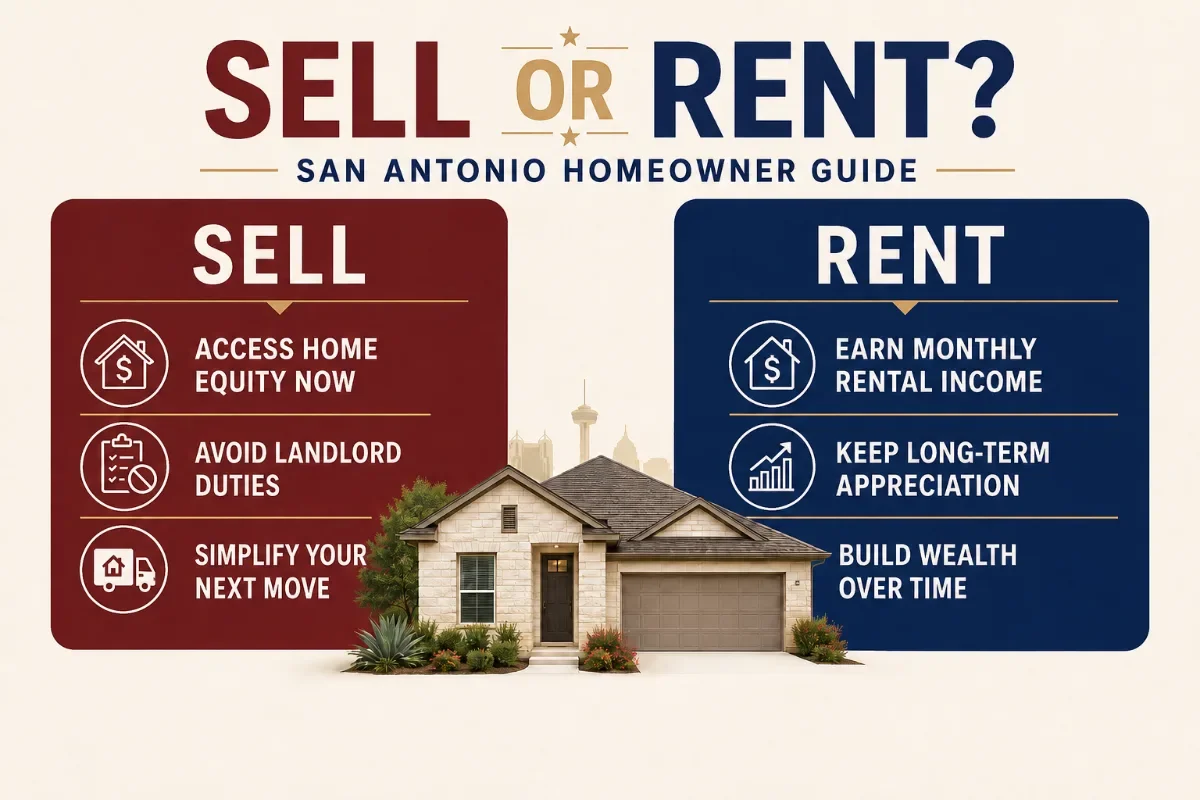
Weigh the pros and cons
Renting makes sense when:
- You have a low mortgage rate and positive or near-breakeven cash flow
- You believe in long-term San Antonio appreciation
- You can absorb an occasional repair or vacancy without stress
- You're moving temporarily and may return
Selling makes sense when:
- You need the equity for your next purchase or another goal
- The home needs major repairs you don't want to fund
- The rental math only breaks even after all real costs
- You want a clean break and no landlord responsibilities
Be honest about the landlord workload
Renting isn't passive income by default. You're responsible for marketing, tenant screening, a legally compliant Texas lease, repairs, rent collection, and handling security deposits correctly — returned within 30 days with an itemized list under Texas law. A single problem tenant or a botched deposit can erase a year of cash flow.
If your rental only breaks even, you're taking on real risk and work for little monthly reward. In that case, the sale — and the capital-gains exclusion — may be the smarter financial move. Run the numbers before you assume renting is automatically the wealth-building choice.
Decide how you'll manage it
If the numbers favor renting, the last question is who does the work. Self-managing saves the fee but costs your time and exposes you to compliance mistakes, though using property management software like Buildium can help streamline rent collection, maintenance requests, and accounting. Hiring a manager — typically 8-10% of monthly rent plus a leasing fee — makes sense if you're relocating, own multiple properties, or simply want the income without the calls.
SA Rents can run a free rental analysis on your San Antonio home — real rent numbers, honest cash-flow math, and a clear view of your options. Explore our property management services or reach out to talk it through.
Frequently Asked Questions
Is it better to sell or rent my house in San Antonio?
It depends on your equity, your cash-flow math, and your goals. If you have a low mortgage rate and the home rents for more than its full monthly carrying cost, renting builds long-term wealth. If you need the cash, face major repairs, or the numbers only break even, selling may be the cleaner move. Run both scenarios before deciding.
What taxes apply if I rent out my house instead of selling?
Rental income is taxable, but you can deduct expenses like mortgage interest, property taxes, insurance, repairs, and depreciation (see IRS Publication 527). Keep in mind that converting a primary home to a rental can eventually affect the capital-gains exclusion you'd get by selling.
How does the capital-gains exclusion work if I sell?
If the home was your primary residence for at least 2 of the last 5 years, you may exclude up to $250,000 of gain ($500,000 for married couples filing jointly) under IRS rules. Renting the home out for too long can cause you to lose that window, so timing matters.
How much rent can I get for my San Antonio house?
Price to comparable homes in your specific neighborhood, not to your mortgage. Rents vary widely between areas like Stone Oak, Alamo Heights, and the far Northwest. Check current metro benchmarks and get a local rental analysis before you decide.
When should I hire a property manager in San Antonio?
Consider a manager if you're relocating, own multiple units, or don't want the calls, repairs, and legal compliance that come with being a landlord. Typical San Antonio management fees run around 8-10% of monthly rent plus a leasing fee — often worth it to protect cash flow and stay compliant with Texas law.
Where can I find official IRS rules on the home sale tax exclusion?
You can review official guidelines on capital gains exclusions for primary residences directly on the IRS Topic No. 701 (Sale of Your Home) page.