
How to Write a Texas Residential Lease Agreement: A Landlord's Guide (2026)
The lease is the single most important document in your rental business. A clear, Texas-compliant lease sets expectations, protects your property, and gives you a solid footing if a dispute ever reaches court. A sloppy one - or a generic template pulled off the internet - can leave required disclosures out and unenforceable clauses in. This guide covers what belongs in a Texas residential lease agreement and the state rules that govern it.
This is general educational information, not legal advice. Texas landlord-tenant law is detailed and fact-specific - consult a licensed Texas attorney before finalizing your lease.
Written vs. oral leases in Texas
Texas recognizes oral leases, but any lease longer than one year must be in writing to be enforceable. There is no good reason to rely on a handshake: put every residential lease in writing, signed by all adult occupants. A written lease is your primary evidence if you ever need to enforce terms or defend a deposit deduction.
The core terms every lease needs
Before the state-specific rules, get the fundamentals right. A complete Texas lease should clearly state:
- The parties and every adult occupant
- The property address and any assigned parking or storage
- The term (start and end dates) and renewal or month-to-month terms
- The rent amount, due date, and accepted payment methods
- The security deposit amount and conditions for its return
- Late-fee terms (see the limits below)
- Maintenance and repair responsibilities and how to request repairs
- Rules on pets, smoking, subletting, and occupancy limits
- Default and remedies, including notice to vacate
Required Texas disclosures and clauses
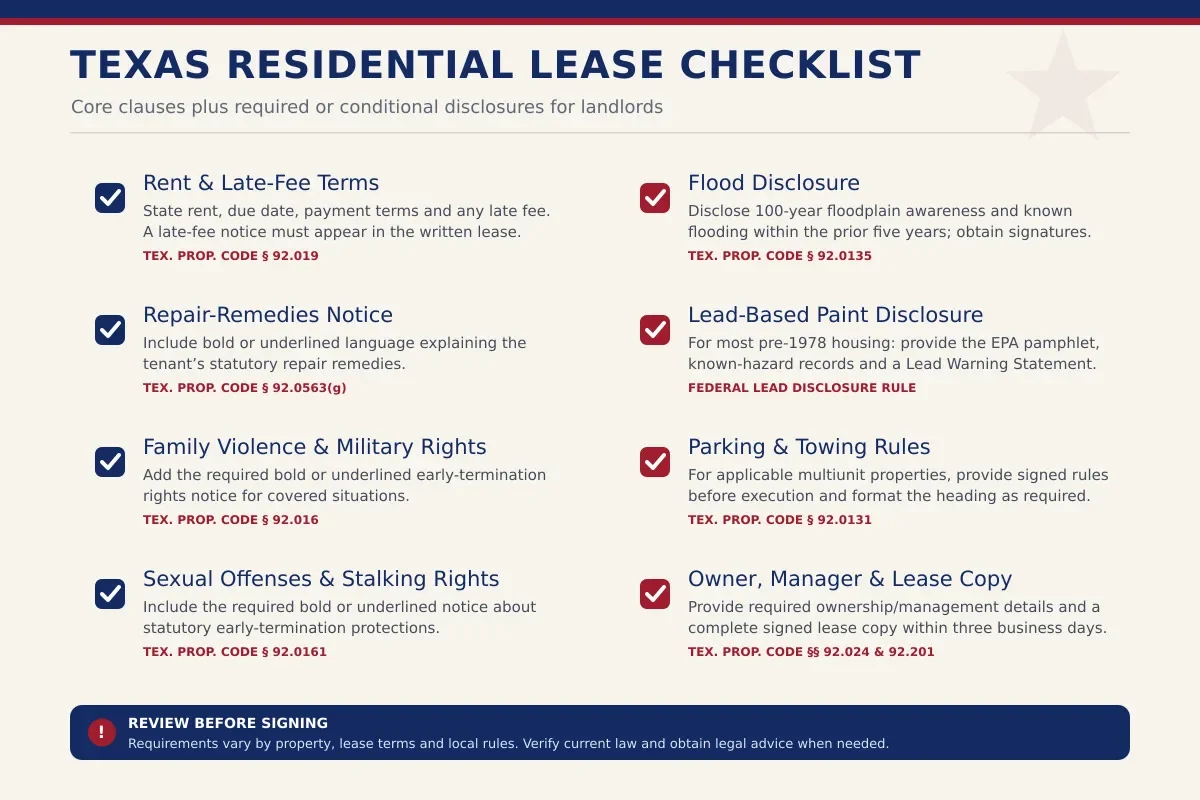
This is where Texas law gets specific. Texas Property Code Chapter 92 governs residential tenancies, and several items must appear or be provided:
- Landlord/manager name and address. You must give the tenant a name and address for notices and legal service.
- Security devices. Texas requires certain security devices - keyed deadbolts, window latches, and door viewers among them - and the lease should address them.
- Repair remedies. Tenants have statutory remedies if you fail to make a diligent effort to repair conditions affecting health and safety after proper written notice.
- Flood disclosure. If the dwelling sits in a 100-year floodplain, or has flooded at least once in the previous five years, Texas law requires you to disclose it - important in flood-prone parts of Bexar County.
- Parking and towing rules for multi-unit properties.
- Federal lead-based paint disclosure for any housing built before 1978, required under federal law regardless of state.
Your lease can set a pet policy, but assistance and emotional support animals are not "pets" under fair housing rules and generally can't be charged a pet deposit. Get this wrong and you risk a fair housing complaint - see our guide to Texas emotional support animal housing laws before you draft your pet clause.
Late fees and rent rules
Texas gives landlords real flexibility on rent - there is no rent control in the state - but late fees are regulated. Under Texas Property Code Sec. 92.019, a late fee must be written into the lease and be reasonable. The statute treats a fee as presumptively reasonable if it does not exceed 12% of the rent for a property with four or fewer dwelling units, or 10% for larger properties. You may only charge the fee once rent is at least two full days late. Skipping the written term, or charging a fee before that two-day mark, makes the charge vulnerable to challenge.
Security deposit terms
Spell out the deposit amount and the conditions for its return in the lease. Under Sec. 92.103, you must refund the deposit - or provide a written, itemized list of deductions - within 30 days after the tenant moves out and gives you a forwarding address. You cannot deduct for normal wear and tear, and a landlord who acts in bad faith can face penalties. Document the unit's condition at move-in and move-out to support any deductions.
Ending the lease and eviction terms
Your lease should describe how the tenancy ends: notice required for non-renewal, holdover terms, and the consequences of default. For nonpayment, Texas generally requires a written notice to vacate before filing an eviction, and your lease can set that notice period. When tenants ask about leaving early, our guide to how to break a lease in Texas explains the limited legal grounds and the landlord's duty to mitigate. If it comes to removal, the eviction process in San Antonio runs through Bexar County's justice courts on a set timeline.
Instead of a generic "free Texas lease template," start from a Texas-specific form and check every clause against Chapter 92. The Texas State Law Library is a reliable, official starting point for understanding your obligations.
Get the lease right the first time
A lease that's missing a disclosure or leaning on an unenforceable clause won't reveal the problem until you're already in a dispute - the worst possible time to find out. Many San Antonio owners have a professional handle the lease so it's compliant, thorough, and consistent across every property.
SA Rents uses attorney-reviewed, Texas-specific leases and handles disclosures, renewals, and enforcement for San Antonio owners. Explore our property management services or reach out to get your leasing set up right.
Frequently Asked Questions
Does a lease have to be in writing in Texas?
Texas allows oral leases, but any lease longer than one year must be in writing to be enforceable under the statute of frauds. In practice you should always put every residential lease in writing - it's your best protection in a dispute.
What disclosures are required in a Texas lease?
Key ones include the name and address of the landlord or manager for notices, the required security-device and repair remedies information under Texas Property Code Chapter 92, a flood disclosure if the unit is in a 100-year floodplain or has flooded, parking/towing rules for multi-unit properties, and the federal lead-based paint disclosure for housing built before 1978.
How much can a landlord charge for a late fee in Texas?
A late fee must be stated in the lease and be reasonable. Texas Property Code Sec. 92.019 treats a fee as presumptively reasonable if it does not exceed 12% of the rent for a property with four or fewer units (10% for larger properties). You can only charge it once rent is at least two full days late.
How long does a Texas landlord have to return a security deposit?
Within 30 days after the tenant surrenders the unit and provides a forwarding address, you must return the deposit or send an itemized list of deductions, under Texas Property Code Sec. 92.103.
Is there a free Texas lease template I can use?
Templates exist, but a generic form often misses required Texas disclosures or includes unenforceable clauses. Use a Texas-specific lease reviewed for Chapter 92 compliance, or have a property manager or attorney provide one tailored to your property.